
WELCOME BONUS 300%
UP TO €2000 + 100
FREE SPINS
UP TO €2000 + 100
FREE SPINS
Home → Blackjack
Blackjack at 24Magic Casino
What the Hole Card Means at a Live Table
A hole card is the dealer's second, face-down card in blackjack, and at a live table it decides whether play continues or the round ends early; the rule set known as Blackjack 6 decks, S17, DAS, DOA, 3:2 payout, basic strategy carries an RTP of 99.54%. That figure sits against a house edge of 0.46%, which is the average share of each stake the casino keeps over the long run. On €100 of stakes the expected cost is therefore €0.46, a number that only holds if the player follows basic strategy on every decision.
The face-down card matters because the dealer checks it for blackjack before the player acts, and that check is what makes the later surrender option possible; Blackjack Surrender, played with late surrender, gives up the hand after that check and returns 50% of the stake. The rule improves the return by about 0.08 percentage points, so the same €100 of stakes costs roughly €0.08 less. Early surrender would be worth up to 0.6 percentage points but is extremely rare, so late surrender is the variant a beginner will actually meet.
Among the live tables, Infinite Blackjack from Evolution runs with a bet range of €1 - €5,000 and an RTP of 99.47%, while Blackjack Party from the same studio takes bets from €1.00 - €1,000. Both are dealt with a physical shoe rather than a random number generator, so the hole card is a real card. The 99.47% return on Infinite Blackjack is 0.07 percentage points below the 99.54% of the six-deck game, which on €100 of stakes is a difference of €0.07.
Six to Eight Decks in the Shoe
The number of decks in the shoe changes the house edge, and Blackjack Single deck under classic rules reaches an RTP of 99.85% with a house edge of 0.15%. One deck is roughly 0.48 percentage points cheaper for the player than eight decks, which sounds like the obvious choice. That gain is often cancelled by a reduced payout: many single-deck tables pay 6:5 instead of 3:2, and the 6:5 version on six decks drops to an RTP of 98.15%.
The arithmetic behind the payout change is exact: replacing 3:2 with 6:5 adds 1.39 percentage points to the casino's edge, more than any other single rule change. On a €10 bet a blackjack pays €12 instead of €15, a shortfall of €3 on that one hand. Over a session of a hundred blackjacks the difference reaches €300, which is why the 3:2 payout is the first thing to check before sitting down.
Between six and eight decks the gap is small: moving from 8 decks to 6 decks is worth about 0.02 percentage points. Blackjack Liberal Vegas Strip, using S17 plus DAS plus resplit plus late surrender, shows what the friendly end of the range looks like at an RTP of 99.72% and a house edge of 0.28%, with a standard deviation of 1.15. The house edge of 0.28% means €100 of stakes costs €0.28 on average across that rule set.
What the Peek Means When the Dealer Shows an Ace
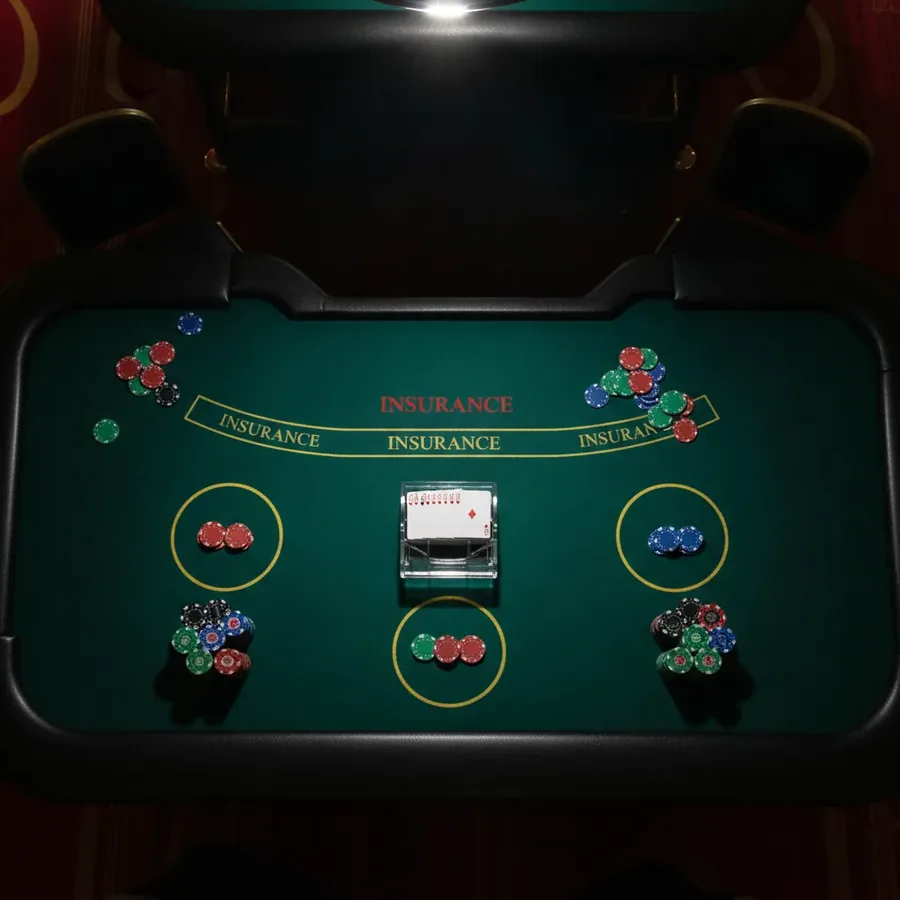
A peek is the dealer's check of the hole card when the upcard is an ace or a ten, and it determines whether the round is already over; Blackjack Insurance is the side bet offered at that moment, a separate wager of up to 50% of the main bet. Insurance pays 2:1, but its RTP on six to eight decks is 92.53%, against a house edge of 7.47%. That is the cost of the side bet itself, not of the main hand.
The gap between the two is the point: €100 staked on insurance loses €7.47 on average, while the same €100 on the six-deck main game at 99.54% loses €0.46. Basic strategy always declines insurance, with the single exception of card counters at a true count of +3 or higher. With a single deck the insurance edge is about 5.88%, still far above the main game.
That 99.56% return is 0.02 percentage points above the six-deck figure of 99.54%, a difference of €0.02 per €100 staked. The insurance side bet remains a separate decision on each of these tables and keeps its 7.47% edge on six to eight decks.
The Insurance Mistake: 7% Extra House Edge
Taking insurance is the most expensive routine mistake at the table, because the side bet carries an RTP of 92.53% and a house edge of 7.47% on six to eight decks. Set that against the main game on the same shoe, where the six-deck rule set returns 99.54% and keeps 0.46%. The additional cost of the side bet is therefore 7.01 percentage points, which on €100 of insurance stakes is €7.01 lost on average.
The figure scales with the size of the bet: insurance allows up to 50% of the main wager, so a €20 main bet permits a €10 insurance stake. At a 7.47% edge that €10 side bet costs €0.75 on average per round, while the €20 main bet at a 0.46% edge costs €0.09. Insurance is therefore the larger leak of the two by a factor of more than eight.
A single-deck game narrows the damage but does not remove it: there the insurance edge is about 5.88%. Blackjack Liberal Vegas Strip, with S17 plus DAS plus resplit plus late surrender, reaches an RTP of 99.72% and a house edge of 0.28%, so €100 of main-game stakes costs €0.28 against €5.88 or €7.47 for the same amount on insurance. Declining the side bet on every dealer ace is the consistent choice outside card counting.
16 vs 10 played incorrectly: most common error
A hard 16 against a dealer 10 is the hand where beginners most often stand instead of hitting, and the cost shows up in the rule figures rather than in one round. Blackjack 6:5 on six decks returns 98.15% and keeps 1.85% for the casino, while the 3:2 version on the same shoe returns 99.54% and keeps 0.46%. A single payout change of that kind moves €1.39 per €100 staked, more than most strategy slips.
Rule choices compound the same way: a dealer who hits soft 17 lowers the return by 0.22 percentage points, resplitting aces improves it by 0.08, doubling after a split adds about 0.14, and six decks instead of eight is worth about 0.02. Blackjack Split and double rules allow up to four hands and a doubled stake with one card, and split aces usually receive one card each. Each of those choices is worth a fraction of a percentage point, so they add up slowly rather than at once.
The base case for a beginner is the six-deck game with S17, DAS and DOA at a 3:2 payout, where basic strategy is required to reach the 99.54% return and the 0.46% house edge. On €100 of stakes that edge costs €0.46 on average, provided every decision follows the strategy. Insurance at 92.53% and 6:5 payouts at 98.15% are the two places where that figure is lost fastest, and the 300% welcome bonus up to €2,000 plus 100 free spins does not change the maths of either.
Blackjack variants at a glance
| Variant | Payout | House edge | Rule | RTP |
|---|---|---|---|---|
| Blackjack Insurance (6–8 decks) | Insurance 2:1 | 7.47% | Separate side bet of up to 50% of the main bet when the dealer shows an ace. Basic strategy ALWAYS declines it (except for card counters at a true count ≥ +3). With a single deck the edge is ≈ 5.88% | 92.53% |
| Blackjack Single deck, classic rules, 3:2 | Blackjack 3:2, win 1:1 | 0.15% | Fewer decks = lower edge; one deck gives about −0.48 percentage points compared with 8 decks. Often offset by a 6:5 payout. | 99.85% |
| Blackjack Split / double / H17 – rule effects | Double – stake ×2 with one card; split – up to 4 hands; split aces usually get one card each. | H17 +0.22 percentage points; RSA −0.08 percentage points; DAS −0.14 percentage points | Dealer hitting soft 17 lowers RTP by 0.22 percentage points; resplitting aces improves it by 0.08 percentage points; doubling after a split improves it by about 0.14 percentage points; 6 decks instead of 8 – about 0.02 percentage points. | n/a (rule modifiers) |
| Blackjack Liberal Vegas Strip (liberal rules, 3:2) | Blackjack 3:2, win 1:1 | 0.28% | The most player-friendly rule set: S17 + DAS + resplit + late surrender. Standard deviation 1.15 | 99.72% |
| Blackjack Surrender (late surrender) – rule effect | 50% of the stake returned | −0.08 percentage points | The player gives up the hand after the dealer has checked for blackjack and loses half the stake. Improves RTP by about 0.08 percentage points. Early surrender is worth much more (up to −0.6 percentage points) but is extremely rare. | n/a (rule modifier) |
| Blackjack 6:5 payout instead of 3:2 (6 decks) | Blackjack 6:5, win 1:1 | 1.85% | Replacing 3:2 with 6:5 adds exactly +1.39 percentage points to the casino's edge – more than any other rule change. On a €10 bet a blackjack pays €12 instead of €15. | 98.15% |
The Shoe, the Cut Card and 75% Penetration
The six-deck shoe used for the main blackjack variant carries a cut card placed by the dealer after the shuffle. Penetration of 75 percent means that roughly four and a half decks are dealt before the shoe ends, leaving one and a half decks behind the cut card. Deeper penetration reduces the effect of deck reshuffling on basic strategy outcomes.
A shoe with six decks and a 75 percent penetration creates longer sequences between reshuffles than a single-deck game with classic rules. The single-deck variant shows a house edge of 0.15 percent, while the six-deck game with stand on soft 17 and 3:2 payouts sits at 0.46 percent. Fewer decks lower the edge by about 0.48 percentage points compared with eight decks, but 75 percent penetration on six decks keeps the game steady and predictable for basic strategy players.
The cut card position affects how many hands a beginner sees before a new shuffle. With six decks and 75 percent penetration, a table round uses fewer reshuffles per hour than a single-deck game, where the dealer must shuffle far more often. On a €10 bet, the expected cost per 100 hands is about €4.60 at the six-deck house edge of 0.46 percent, while the single-deck classic game would cost about €1.50 per 100 hands at the same stake.
Stop the Session After a 30 Percent Loss
A session stop after a 30 percent loss means that a player sets a hard limit before starting and ends the session when the bankroll drops by that share. On a starting balance of €200, the stop triggers at €140, leaving €140 untouched for another day. This is a money-management rule, not a game strategy, and it does not change the house edge of any blackjack variant. The six-deck game with 3:2 payouts keeps a house edge of 0.46 percent regardless of when a player stands up.
For a beginner using a €10 flat bet, a 30 percent loss on a €300 session bankroll equals €90, or nine consecutive losing hands. The same stop on a €1,000 bankroll equals €300 and would take 30 losing €10 bets. Insurance side bets accelerate the path to that stop because the insurance row shows a house edge of 7.47 percent, far above the 0.46 percent of the main 3:2 six-deck game. A player who takes insurance on a €10 bet repeatedly pays a much higher average cost per hand.
The 30 percent stop is easiest to apply at tables with a wide bet range. Evolution's Infinite Blackjack accepts bets from €1 to €5,000, so a small bankroll of €50 can run many hands before the €15 stop triggers, while a €1,000 bankroll reaches the €300 stop after a longer or shorter run depending on variance. The stop does not improve RTP, which for Infinite Blackjack is 99.47 percent, but it caps the damage from the 0.53 percent house edge in a single session.
What a Natural Blackjack Actually Pays
A natural blackjack pays 3:2 in the standard six-deck game, so a €10 stake returns €15, while the same hand in a 6:5 version returns only €12. The 3:2 rule set carries an RTP of 99.54% and a house edge of 0.46%. That €3 difference per blackjack compounds across many hands, which is why the payout ratio matters more than most players assume.
Switching from 3:2 to 6:5 adds exactly 1.39 percentage points to the casino's edge, pushing the house edge to 1.85% and lowering RTP to 98.15%. No other single rule change costs the player more. On 100 € of total stakes, the 6:5 version keeps 1.85 € on average against 0.46 € for the 3:2 game.
Insurance is a separate side bet of up to 50% of the main bet, offered when the dealer shows an ace, and it pays 2:1. Its RTP is 92.53% with a house edge of 7.47%, and basic strategy always declines it. A €10 insurance bet therefore returns €9.25 on average, below the main game's 99.54%.
Doubling After a Split: Which Tables Allow It
The six-deck blackjack variant with stand on soft 17 allows doubling after a split, listed as DAS in the rule set. A player who splits a pair and then doubles on one of the resulting hands places a second stake equal to the first and receives exactly one more card. Doubling after a split improves RTP by about 0.14 percentage points compared with a table that forbids it. On a €10 split hand, the double down adds another €10 to that hand, so the total risk on that spot becomes €20.
The liberal Vegas Strip rule set also permits doubling after a split, and it adds resplitting aces and late surrender. That combination produces a house edge of 0.28 percent, which is lower than the 0.46 percent of the standard six-deck game. The effect of DAS is worth about 0.14 percentage points, while resplitting aces adds another 0.08 percentage points and late surrender adds 0.08 percentage points. A beginner should look for the DAS marker before sitting down.
The rule effects row states that doubling after a split carries a stake multiplier of two with one card, and a split may run to up to four hands. Split aces usually receive one card each, which limits the value of resplitting aces even when allowed. At Evolution's Infinite Blackjack, the bet range of €1 to €5,000 means a split-and-double sequence can grow quickly from a small starting bet, but the RTP of 99.47 percent still assumes correct basic strategy on every decision.
Double Down or Just Hit on 11
Doubling down on a first two-card total of 11 means the stake is doubled and exactly one more card is dealt, so a €10 bet becomes €20 committed before that card falls. The alternative, a simple hit, keeps the original stake live and allows further cards, which matters because the double converts a strong starting total into twice the exposure with no option to draw again.
Across the benchmark six-deck game, 3:2 payout, dealer stands on soft 17, doubling after a split allowed, no surrender, the house edge is 0.46% and the RTP is 99.54% under basic strategy. Doubling after a split is worth about 0.14 percentage points of return, and resplitting aces adds 0.08 percentage points, so rule access to the double directly changes the cost of every decision made on 11.
On €100 of stakes placed this way, the benchmark edge of 0.46% costs €0.46 on average, whereas the same money pushed into the 6:5 payout version costs €1.85, a difference of €1.39 per €100. A blackjack on a €10 bet pays €12 at 6:5 against €15 at 3:2, so the payout line and the double decision have to be read together.
Soft vs Hard Hands in Practice
A soft hand contains an ace counted as 11, so a soft 17 can be reduced to a hard 7 by revaluing that ace as 1; a hard hand has no such flexibility because no ace is currently counted as 11. The dealer rule that decides the outcome is whether the dealer hits or stands on soft 17, and that single choice moves the house edge by 0.22 percentage points.
In the six-deck benchmark with the dealer standing on soft 17, doubling allowed on any first two cards and doubling after a split permitted, the RTP is 99.54% and the house edge is 0.46%. Letting the dealer hit soft 17 instead lowers the return by 0.22 percentage points, which is the same order of magnitude as the 0.14 percentage points gained from doubling after a split and the 0.08 percentage points gained from resplitting aces.
Per €100 staked, the difference between the two dealer rules is €0.22 on average, before any payout change is applied. The most player-friendly rule set, the liberal Vegas Strip line with standing on soft 17, doubling after a split, resplitting and late surrender, reaches an RTP of 99.72% and a house edge of 0.28%, with a standard deviation of 1.15, so the soft-17 treatment sits inside a much larger package of rules.
Insurance vs Even Money When You Hold Blackjack
Insurance is a separate side bet of up to 50% of the main bet, offered when the dealer shows an ace, and it pays 2:1; with six to eight decks it returns 92.53% and carries a house edge of 7.47%. Taking even money instead means accepting a 1:1 payout on an own blackjack before the dealer checks the hole card, which removes the risk of a push against a dealer blackjack.
Basic strategy always declines insurance except for card counters at a true count of at least +3, because the 7.47% edge on that side bet is far above the 0.46% edge of the benchmark six-deck game. With a single deck the insurance edge is approximately 5.88%, still many times the cost of the main wager, so the side bet remains the more expensive of the two decisions in every deck count named.
On €100 of insurance stakes, the average cost is €7.47 with six to eight decks, against €0.46 for €100 staked on the main game under the benchmark rules. A player holding a blackjack on a €10 bet sees €12 at 6:5 and €15 at 3:2, so the even-money decision interacts with the payout line rather than standing alone.
No Doubling Down on Three Cards
Doubling down is restricted to the first two cards, so a three-card total cannot be doubled; the option is spent once the third card is taken. The benchmark six-deck game with a 3:2 payout, dealer standing on soft 17, doubling on any first two cards, doubling after a split allowed and no surrender reaches an RTP of 99.54% and a house edge of 0.46%, and that figure assumes the double is used at the correct moment on two cards only.
Doubling after a split is worth about 0.14 percentage points of return and resplitting aces adds 0.08 percentage points, both of which depend on the double being available at the two-card stage. Moving from eight decks to six decks is worth roughly 0.02 percentage points, while a single deck is about 0.48 percentage points better than eight decks, though that gain is often offset when the payout drops to 6:5.
The payout line dominates: replacing 3:2 with 6:5 at six decks adds exactly 1.39 percentage points to the casino's edge, taking the house edge from 0.46% to 1.85% and the RTP from 99.54% to 98.15%. Per €100 staked, that is €1.85 instead of €0.46, a gap far larger than any gain from deck count or from the two-card double itself.
Splitting Eights vs Standing on 16
Splitting a pair of eights turns one 16 into two separate hands, and the split can run to up to four hands, with split aces usually receiving one card each. Standing on 16 keeps a single hand against the dealer, so the comparison is between two hands each starting from 8 and one hand locked at a total that cannot be improved without risk.
In the benchmark six-deck game with a 3:2 payout, dealer standing on soft 17, doubling on any first two cards and no surrender, the RTP is 99.54% and the house edge is 0.46%, and that figure assumes basic strategy is followed on every split decision. Doubling after a split improves the return by about 0.14 percentage points and resplitting aces by 0.08 percentage points, so the value of splitting depends on those follow-up rights being available.
On €100 of stakes, the benchmark edge costs €0.46 on average, while the same €100 in the 6:5 version costs €1.85, a difference of €1.39. A blackjack pays €15 on a €10 bet at 3:2 and €12 at 6:5, so the payout line has to be checked before the split is judged worthwhile.
Contact
Live - online chat
Banking









Providers












24Magic Casino 2026